

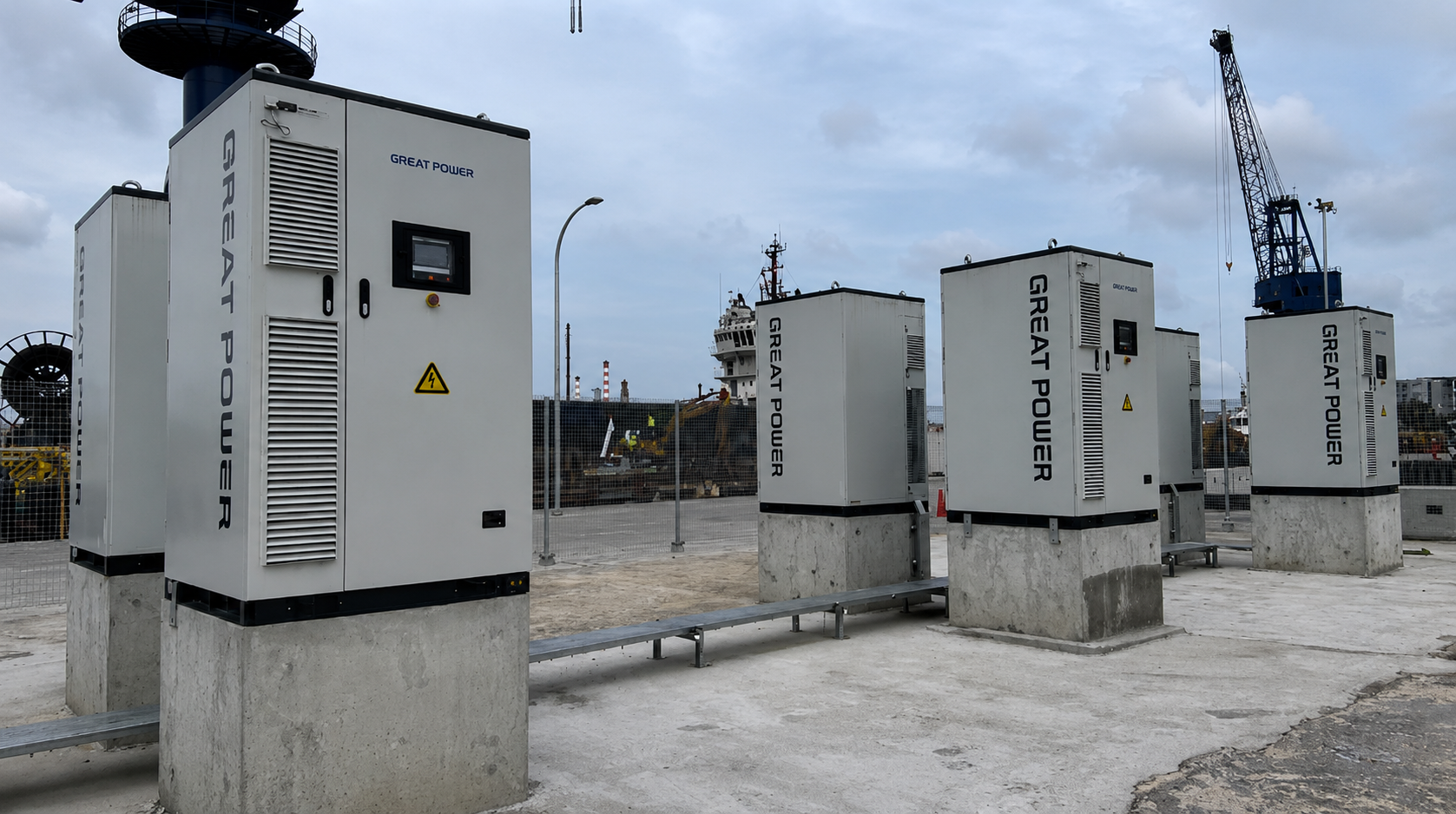

PaxOcean powers a greener 5JS shipyard with Battery Energy Storage for peak shaving and load management
Customer Profile

About the customer
PaxOcean owns and operates 5 shipyards located in Singapore, China and Indonesia. First established in 2007 in Singapore, PaxOcean offers a wide range of services covering newbuilding, module fabrication, green recycling, repairs and conversion of conventional and renewable energy assets

Location:
Singapore

Industry:
Maritime

Project Completion:
2026
The Opportunity
PaxOcean's Power Station at 5 Jalan Samulun, Singapore, runs a demanding electrical load. Heavy machinery, shore-to-ship power, and continuous shipyard operations create sharp, unpredictable spikes in demand, the kind that push a facility uncomfortably close to its contracted capacity limit. Every time that limit is breached, penalty charges follow. Every time capacity is set too high just to stay safe, the business pays for headroom it rarely uses.
For a maritime operation of this scale, the brief was clear: build a system that could absorb these spikes automatically, keep load reliably under contracted capacity, and do it without adding operational burden to the team on site. Sustainability leadership was part of the brief too, PaxOcean wanted a scalable, demand-responsive energy model that could stand as a reference point for the wider maritime industry.
Our Approach
Vector Green delivered the project as system integrator, from engineering through to commissioning, deploying a 600kVA / 1000kWh battery energy storage system built around Great Power's PCS platform.
The core of the solution is automation, not manual oversight. The BESS was integrated with Schneider Electric's EcoStruxure Microgrid Operation suite, EMO-L for real-time control, EPO for SCADA visualisation, and EMA for cloud-based remote monitoring, all coordinated through a T300 data concentrator that ties together the power meters, PV inputs, and the battery system itself.
On top of that platform, we configured a rules-based peak shaving logic tailored to PaxOcean's actual load profile. The battery discharges automatically whenever MSB-3 load or total site load approaches the transformer and grid supply thresholds, and stands down once battery state of charge hits safe limits, protecting the asset from over-discharge. Charging follows the inverse logic, drawing power during low-load windows so the battery is ready before the next spike arrives. None of this requires a human in the loop to trigger it.
The Outcome
The result is a facility that manages its own peak demand in real time. Load is automatically shifted away from the grid during high-demand moments, keeping PaxOcean reliably under its contracted capacity rather than depending on manual intervention or accepting penalty risk as a cost of doing business.
Beyond the numbers, this project positions PaxOcean, and Vector Green, at the front of a shift the maritime and heavy industrial sector is only beginning to make: treating energy storage as active infrastructure, not passive backup. It is a working demonstration of what a scalable, demand-responsive energy system looks like in a live shipyard environment, and a model we are well placed to bring to comparable facilities across Singapore.
