

Electrifying your fleet? Singapore's contracted capacity penalties could cost you 12x your normal bill
02/04/2026
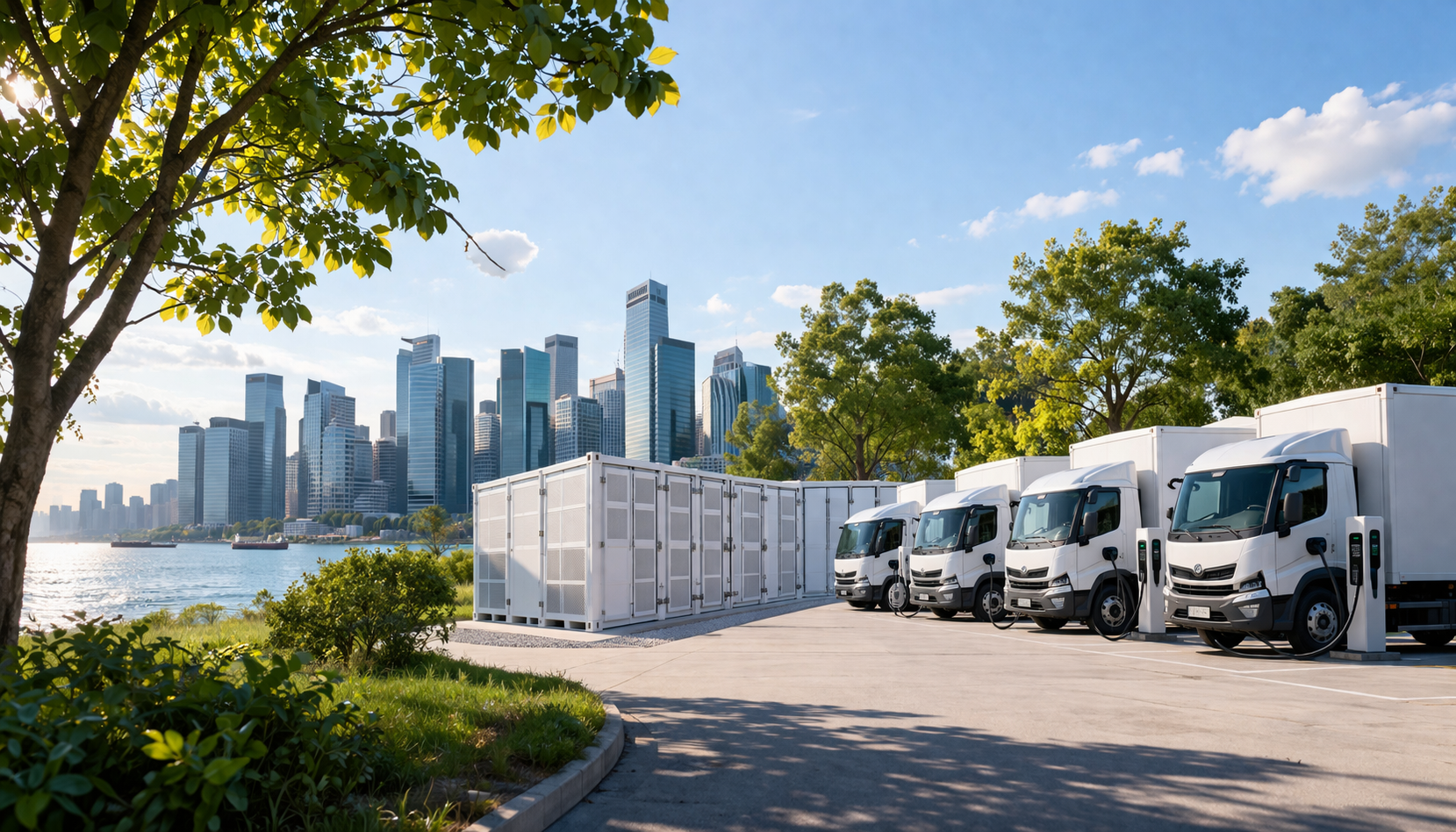
Most businesses in Singapore have never heard of Contracted Capacity penalties. The ones installing EV chargers without a Battery Energy Storage System are about to find out the hard way. Here is what the risk is, who faces it, and how BESS turns a compliance cost into a revenue-generating asset.
The penalty most fleet operators have never heard of
When your business connected to the electricity grid in Singapore, you signed a Connection Agreement with SP Group declaring a maximum kW figure. This number is the most power you will ever draw from the grid at any one time, and it is called your Contracted Capacity (CC). It is locked in for a minimum five-year period. You pay a monthly Contracted Capacity Charge whether you use the full amount or not, and you cannot reduce it during the lock-in window.
That arrangement works fine when your electricity demand is predictable. It becomes a serious financial threat the moment you start installing EV chargers.
Why this matters right now: A single DC fast charger draws between 150 and 360 kW. A fleet of 10 buses charging at the same time can add 1,500 to 3,600 kW of instantaneous demand, which is enough to double or triple a depot's existing Contracted Capacity in a single event. SP Group advises customers needing large CC upgrades to plan 5 to 8 years in advance. The government's HVZES electrification incentives launch in January 2026.
What happens when you exceed your Contracted Capacity
SP Group operates a tiered penalty structure for businesses that breach their CC. The figures below are not theoretical. They are written into your Connection Agreement.
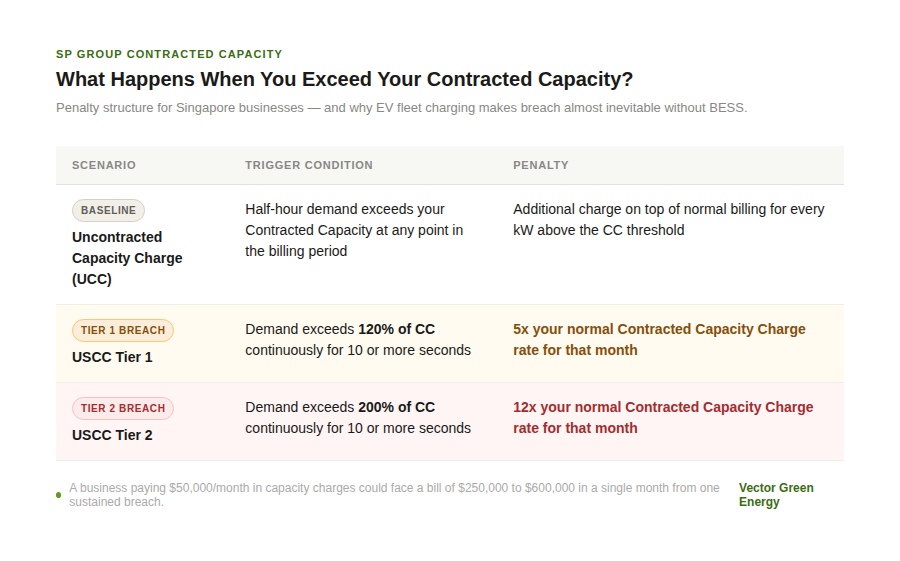
To make that concrete: a business paying $50,000 per month in normal capacity charges could face a bill of $250,000 to $600,000 in a single month if their EV charging causes a sustained breach. This is not a fringe risk. It is a mathematical certainty for any fleet operator who electrifies without managing peak demand first.
The Contracted Capacity trap has always existed. Fleet electrification is what turns it from a background concern into an acute, government-mandated crisis.
Why Singapore businesses have no easy alternative to BESS
The obvious question is: why not just upgrade the Contracted Capacity? The answer is that it takes far longer than most businesses assume. SP Group recommends planning large CC upgrades 5 to 8 years in advance. Even a standard upgrade can take many months. Substations in Singapore's dense urban environment require significant lead time, civil works, and regulatory approvals before a single additional kilowatt can be drawn.
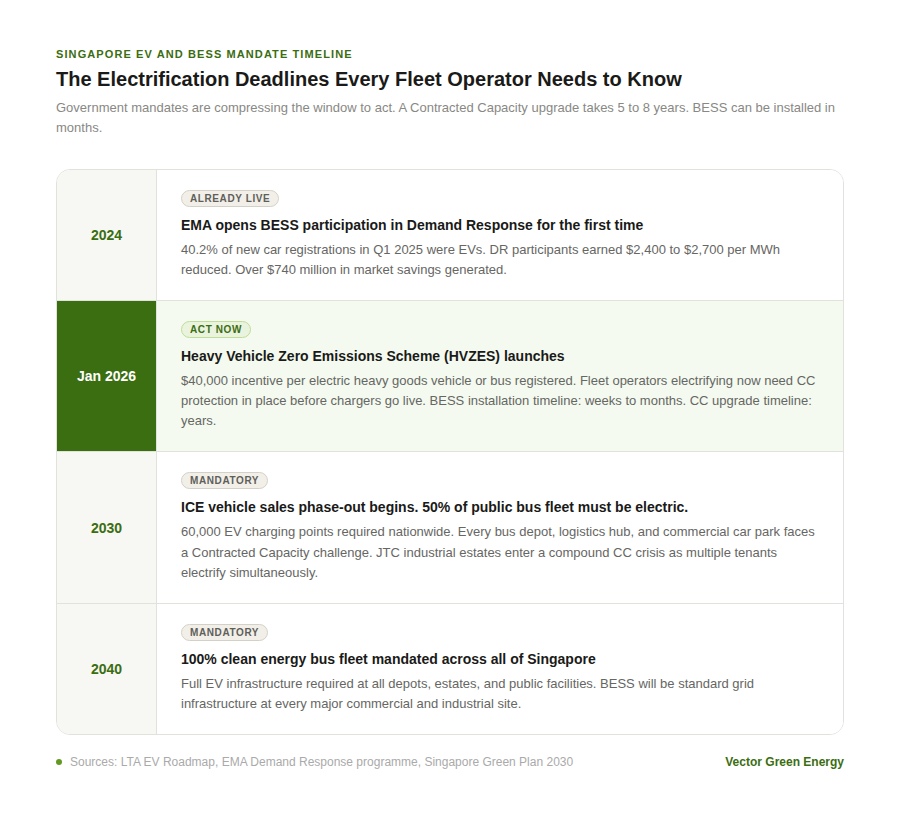
The HVZES programme launches January 2026. ICE vehicle sales phase out from 2030. The gap between the time needed to upgrade CC and the time available before electrification mandates is exactly where the problem lives, and where BESS becomes the only solution that works on the required timeline.
Singapore also faces structural constraints that make BESS uniquely necessary here compared to other markets. There is no hydroelectric or viable wind generation, limited land for solar, and no grid interconnection with neighbours at the scale needed to buffer large demand spikes. As EMA's energy supply overview makes clear, solar is the primary domestic renewable option and it is intermittent. Every EV charger added needs a buffer, and BESS is the technology that provides it at the speed the mandate requires.
The mandate timeline: why the window is narrow
How BESS solves three problems at once
A BESS installation does not just protect you from CC penalties. When sized and commissioned correctly, it addresses three distinct value drivers. This is why it is more accurate to frame BESS as a revenue-generating asset rather than a compliance cost.
CC penalty protection :BESS charges at off-peak hours within your existing CC limit. When EV chargers spike demand, the system discharges automatically within milliseconds, keeping your total grid draw below the CC threshold. No breach, no UCC, no 5x or 12x multiplier.
Peak shaving and bill reduction: Charge the BESS at off-peak electricity rates overnight. Discharge stored energy during peak tariff hours instead of drawing from the grid. The Energy Management System handles this automatically based on live price signals, with potential savings of up to 30% on monthly electricity bills.
Demand Response income: With BESS installed, your facility can register for Singapore's EMA Demand Response programme and earn standby and activation payments, simply for being available when the grid needs flexibility.
The water tank analogy: Your Contracted Capacity is like a water pipe with a fixed maximum flow rate. When your EVs all plug in at once, it is like 10 taps opening simultaneously and the pressure exceeds the limit, triggering penalties. A BESS works like a tank installed on your property. It fills quietly overnight when demand is low. When everyone turns on their taps during the day, they draw from the tank rather than the main pipe. The pressure never breaches the limit. No fines, no CC upgrade, no waiting years for SP Group.
The Demand Response opportunity most businesses do not know exists
This is the part of the BESS value proposition that changes the financial case entirely. Singapore's electricity grid sometimes experiences stress from a heatwave driving HVAC loads, a generation unit tripping offline, or a sudden surge in industrial demand. When that happens, EMA's Demand Response programme activates participating businesses and asks them to temporarily reduce their grid draw.
If your BESS absorbs the load instead of the grid during that period, you receive an incentive payment. Even if you are never actually called on, you earn a standby payment just for being registered and available to respond.
EMA opened BESS participation in the Demand Response programme in late 2024 for the first time. Businesses with BESS below 10MW can now participate. Between 2023 and mid-2024, DR participants earned an average of $2,400 to $2,700 per MWh of electricity reduced, with the programme generating over $740 million in savings across the wholesale electricity market. According to EMA's own commissioned study, there is over 400MW of demand flexibility potential still untapped in Singapore.
DR aggregators currently active in Singapore include SP Group, Geneco, and Enel X. When Vector Green installs and commissions your BESS, we handle all EMA authority submissions and hand over a fully DR-ready system. You then sign directly with a DR aggregator of your choice. We facilitate that handoff at no additional cost.
Who needs to act first
Every segment of Singapore's commercial and industrial property market faces some version of the CC and electrification challenge. These are the groups where urgency is highest right now.
Fleet operators and bus depots: HVZES incentives launch January 2026. Each DC fast charger draws 150 to 360 kW. A 50-vehicle fleet could add 7,500 to 18,000 kW of demand against an existing CC of 2,000 to 5,000 kW. BESS is the only solution deployable within the available time.
Industrial and logistics parks: Multiple tenants electrifying at the same time creates a compound CC problem at the shared substation level. A single estate-level BESS protects all tenants at once.
Commercial buildings and REITs: Tenants and residents are demanding EV chargers. Installing 20 chargers in a car park pushes evening peak demand beyond the existing CC. Pair BESS with rooftop solar and the building qualifies for DR income and improved GreenMark certification at the same time.
Data centres and EV charging operators: Data centres can replace diesel UPS with BESS, which is cleaner, lower maintenance, and DR-eligible when not needed for backup power. EV charging operators blocked by limited grid headroom can deploy fast chargers at previously impossible locations.
What Vector Green delivers
Vector Green designs, supplies, and installs BESS systems for commercial and industrial clients across Singapore. We manage the full project scope, from authority submissions and EMA compliance through to commissioning and DR programme handover. System sizing and load analysis are handled by our technology partner. We own the installation and commissioning end-to-end.
If you are a fleet operator, logistics park manager, REIT, or data centre operator asking how to electrify without breaching your Contracted Capacity, or how to turn an existing solar installation into a DR-eligible revenue asset, those are exactly the questions our team works through with clients every week.
To understand what a BESS installation scoped to your site and load profile looks like, visit our solutions page or speak directly with our energy team.
energy and assets
