

Battery Energy Storage: what it is, and why more businesses are switching it on
17/08/2026
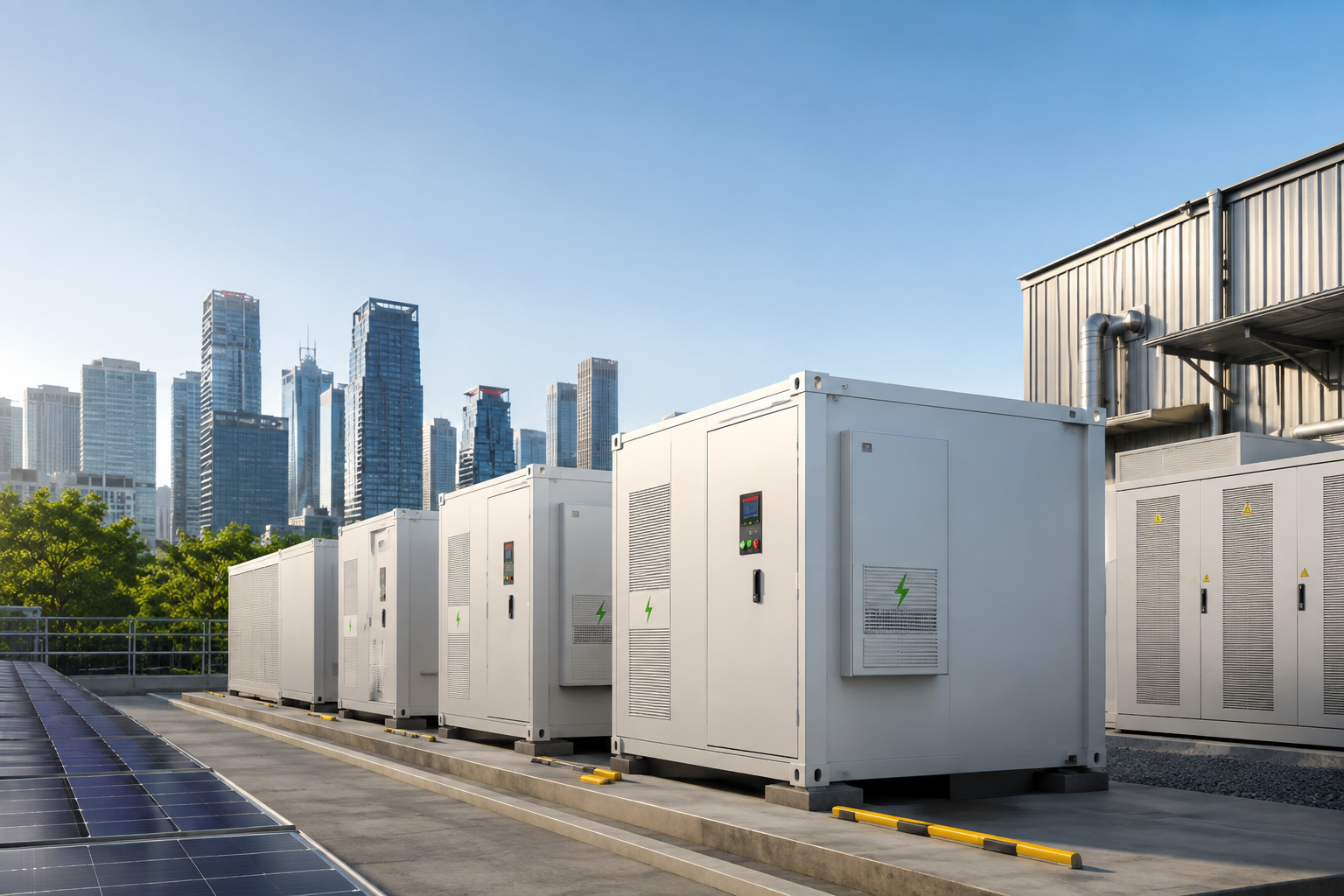
If you run a business in Singapore, you have probably noticed your electricity bill has become less predictable. Some months it spikes for reasons that are not entirely clear. Some machines seem to draw far more power at certain times than others. And every time tariffs go up, your margins take the hit first.
This is where battery energy storage systems, or BESS, are starting to show up in conversations that used to be purely technical. Increasingly, they are business conversations instead.
This article explains what battery energy storage actually is, in plain terms, when your business might genuinely need one, and why the way a battery system is managed matters just as much as the battery itself.
What is Battery Energy Storage, really?
Strip away the acronyms and the concept is simple. A battery energy storage system stores electricity when it is cheap, abundant, or otherwise available, and releases it later when you need it most.
Think of it like a water tank for electricity. A water tank does not create water. It holds water you already have access to, so you are not entirely dependent on the mains supply at every single moment. A BESS does the same thing with power. It does not generate electricity. It stores it, then discharges it back into your operations when the timing makes more sense for your business.
For a commercial or industrial facility, that stored electricity typically comes from one of two places:
-
The grid, during off-peak hours. Electricity tariffs are not flat throughout the day. A battery can charge up when rates are lower and discharge during the more expensive peak periods, effectively letting your business buy low and use later.
-
Solar panels, if you have them. Solar generates electricity during daylight hours, which does not always line up with when your business actually needs power. A battery captures the solar energy you are not using immediately and holds it for later, including after the sun goes down.
Either way, the outcome for the business owner is the same: more control over when and how you consume electricity, instead of being fully at the mercy of the grid and its pricing.
When does a business actually need one?
Battery storage is not universally necessary, and any honest advisor should tell you that upfront. It becomes genuinely relevant when a business hits certain patterns. Here are the signs worth paying attention to.
-
Your energy costs are a growing, visible line item. If your finance team can point to electricity as one of your top five operating costs, and that line has been trending upward, it is worth examining whether some of that spend is avoidable rather than fixed.
-
You have sharp, short bursts of high power demand. Many commercial tariffs are not just about how much electricity you use, but how much you draw at your single highest moment, known as peak demand. A cold room compressor kicking in, a production line starting up, or several pieces of equipment running simultaneously can send that peak demand charge climbing, even if your average usage across the month is unremarkable. A battery can smooth out these spikes by supplying the extra power itself, rather than pulling it all from the grid at once. This practice has a name: peak shaving, and it is one of the more direct ways a battery pays for itself.
-
Your contracted capacity feels too high, or you keep breaching it. If your business is on a contract with a set capacity limit, you are effectively paying for the right to draw a certain maximum amount of power, whether you use it or not. Set that contracted capacity too high, and you are paying for headroom you rarely touch. Set it too low, and every time your actual demand exceeds it, you risk penalty charges on top of your normal bill. A battery gives you a buffer. It can supply the extra power during those brief overshoot moments, which means you can safely contract a lower capacity level without the risk of breaching it, and let the battery, not the grid, absorb the spikes. Our BESS deployment at PaxOcean's shipyard facility at 5 Jalan Samulun shows how this played out in practice.
-
You already have solar, or are considering it. Solar without storage means you are often exporting excess power back to the grid at a lower value than you paid to generate it, or worse, generating power you simply cannot use in real time. Storage lets you capture more of the value from panels you have already invested in.
-
You are under pressure to report on sustainability. Whether it is a corporate parent, an investor, or a retail customer asking about your environmental footprint, energy storage paired with renewables is one of the more concrete, measurable steps a facility can point to.
If none of these apply to your business today, that is a perfectly reasonable answer, and a battery system may not yet be the right investment. But if two or three of these sound familiar, it is worth a proper conversation.
A bonus layer: Demand Response
Everything above is about protecting your own bill. There is a separate opportunity worth knowing about once a battery is already on site: demand response.
Some grid operators and utilities run programmes that pay businesses to reduce or shift their load during periods of system-wide stress, when overall demand threatens to outpace supply. A battery capable of discharging on short notice puts a business in a position to participate in these programmes if and when they are available, turning what is otherwise a cost-avoidance asset into a potential revenue one as well.
This is not a reason on its own to invest in battery storage, and eligibility and programme terms vary, so it is worth confirming for your specific facility rather than assuming it applies. But it is a meaningful bonus for a business that is already installing a system for peak shaving or solar optimisation.
Why management is the part that actually matters
Here is where many businesses get the wrong impression. They assume the value of battery storage lies entirely in the hardware, in having a battery physically installed on site. The battery is necessary, but it is not sufficient on its own.
A battery that simply charges and discharges on a fixed schedule, without any intelligence behind it, leaves a significant amount of value on the table. The real advantage comes from how the system is managed.
-
Timing decisions need to be made constantly. Electricity prices, your facility's actual demand, and weather conditions affecting solar generation all shift throughout the day. A well-managed system is making decisions in real time about when to charge, when to hold, and when to discharge, based on what is actually happening, not a static timetable set once and forgotten. Peak shaving in particular depends on this. The system needs to recognise a demand spike building up and respond within seconds, not react after your contracted capacity has already been breached.
-
Battery health needs active oversight. Batteries degrade faster when they are charged and discharged carelessly, for example being run all the way to empty and back to full repeatedly. Proper management extends the working life of the asset, which directly affects the return on your investment.
-
Data needs to be visible and usable. A facility manager should be able to see, in plain terms, how much the system saved this month, how it performed against peak demand events, and whether it is operating as expected. Without this visibility, it becomes difficult to justify the investment to finance or to catch problems before they become expensive.
-
Integration with the rest of your operations matters. A battery that operates in isolation, disconnected from your building's broader energy monitoring, will always underperform one that works as part of a coordinated system, responding to what your solar panels, your main equipment, and your grid connection are doing at any given moment.
This is really the difference between simply owning a battery and running an energy storage strategy. The equipment is the starting point. The management layer is what determines whether that equipment earns its keep.
Making the Decision
If you are a business owner or facility manager weighing this up, the honest starting point is not "should I buy a battery." It is "where exactly is my energy spend going, and which parts of it are avoidable." That question usually requires a proper look at your actual consumption data, your tariff structure, and your peak demand patterns, not a generic estimate. Our BESS solutions page breaks down how that assessment works.
Battery energy storage is not a trend to follow for its own sake. For the right business, with the right usage profile and the right management behind the system, it is a genuine lever on operating costs and operational resilience. For others, it may be premature, or a smaller step like improving energy monitoring first may make more sense.
Either way, that conversation starts with real numbers, not assumptions. If you want to know whether battery storage makes sense for your facility, Vector Green can walk through your actual consumption data, tariff structure, and peak demand patterns, and give you a straight answer, even if that answer is "not yet." Get in touch to start that conversation.
Frequently Asked Questions
Is battery energy storage the same as a generator or a UPS?
No. A generator creates new electricity, usually by burning fuel, and a UPS is designed purely for short backup power during an outage. A BESS stores electricity you already have access to, from the grid or from solar, and releases it strategically. Some systems can also provide backup power, but that is a secondary function, not the main purpose.
How much battery capacity does my business actually need?
This depends on your peak demand, your consumption pattern throughout the day, and what you are trying to solve for, whether that is peak shaving, backup resilience, or maximising solar self-consumption. There is no standard size that fits every business. It needs to be sized against your actual data.
Does a battery system require a lot of maintenance?
Modern commercial battery systems are largely automated and require relatively little hands-on maintenance compared to a generator. What matters more is software-level oversight, monitoring battery health and performance remotely, rather than physical upkeep.
Can I add battery storage if I don't have solar panels yet?
Yes. A battery on its own can still deliver value through peak shaving and contracted capacity management, since both of those relate to how you draw power from the grid, not to solar generation. Solar simply adds a second source of value on top.
Are there grants or incentives for battery storage in Singapore?
Support schemes and grant availability change over time, so this is worth confirming directly for your specific business rather than relying on a general answer here. It is one of the first things worth asking about in an initial consultation.
energy and assets
