

Budget 2026 and Singapore’s Net Zero strategy: What carbon pricing and renewable energy expansion mean for businesses
13/02/2026
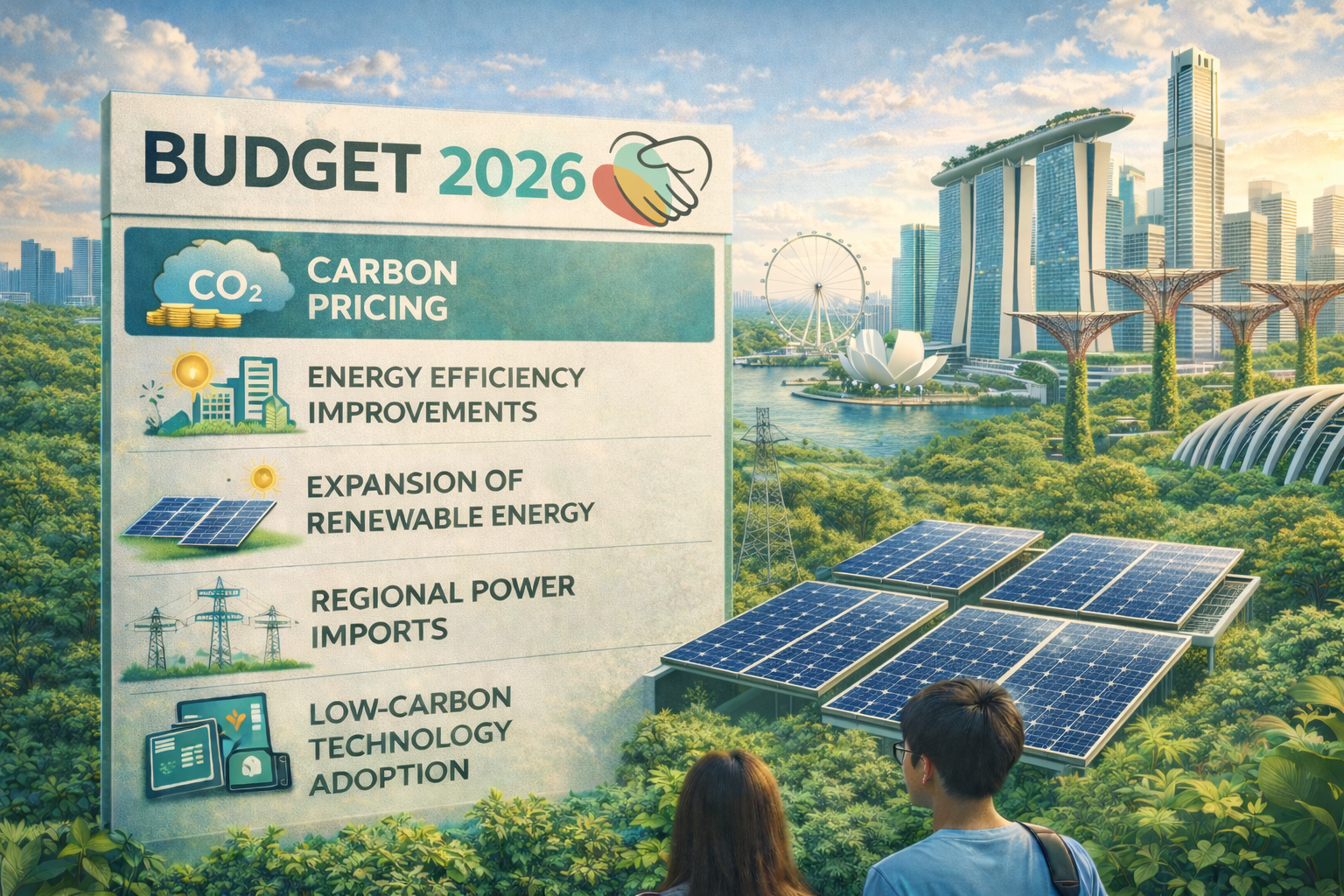
Singapore’s Budget 2026 reinforces a consistent and structured direction in the nation’s journey toward net zero emissions. From the rise in carbon tax to the continued expansion of renewable energy capacity, the policy signals are clear: decarbonisation is no longer a long-term aspiration. It is embedded into the economic system.
For businesses operating in Singapore, these developments influence cost structures, investment planning, risk exposure, and long-term competitiveness. Budget 2026 is not simply a fiscal announcement. It is a strategic milestone in Singapore’s broader decarbonisation roadmap.
This article examines what Budget 2026 means in practical terms and how it aligns with Singapore’s net zero ambitions.
Carbon tax in 2026: A structural shift in business costs
A central feature of Singapore’s decarbonisation framework is carbon pricing.
Singapore’s carbon tax was previously set at S$5 per tonne. It increased to S$25 per tonne in 2024 and 2025, and will rise to S$45 per tonne in 2026. The long-term trajectory indicates a level between S$50 and S$80 per tonne by 2030, with current signals suggesting it may land at the lower end of that range depending on global climate developments. This represents a significant escalation within a relatively short time frame.
Carbon pricing is designed to internalise the cost of emissions. By attaching a financial value to carbon output, the Government incentivises emissions reduction, operational efficiency, and investment in cleaner technologies. From a policy perspective, this aligns Singapore with global decarbonisation trends and strengthens its credibility in international climate commitments. From a business perspective, however, it introduces a measurable and recurring cost.
For energy-intensive sectors such as manufacturing, data centres, petrochemicals, logistics, and large commercial developments, carbon pricing directly affects operating expenditure. Even companies not directly liable for carbon tax may experience indirect cost increases through supply chains and electricity pricing.
The key implication is that carbon is now a structural cost variable in Singapore’s economy.
Budget 2026 and the acceleration of decarbonisation
Beyond carbon pricing, Budget 2026 reinforces Singapore’s broader decarbonisation strategy, which rests on several pillars:
-
Carbon pricing
-
Energy efficiency improvements
-
Expansion of renewable energy
-
Regional power imports
-
Low-carbon technology adoption
This multi-pronged approach reflects a pragmatic understanding of Singapore’s constraints as a land-scarce and resource-limited nation. Decarbonisation cannot rely on a single solution, it requires systemic adjustment across energy supply, infrastructure, and industrial processes, and as Prime Minister Lawrence Wong noted, progress will also depend on technological breakthroughs.
Budget 2026 signals continuity rather than disruption. The direction of travel remains firm. For corporate leaders, this policy consistency reduces uncertainty. Regulatory pressure is increasing, but it is doing so with transparency.
Renewable energy expansion: solar capacity reaches new milestones
Singapore has achieved its earlier solar deployment target of 2 gigawatt-peak (GWp) ahead of 2030 and has raised its ambition to 3GWp by 2030. In a land-constrained urban environment, this milestone is significant.
Solar deployment in Singapore requires creative integration. Rooftop systems, floating solar installations, and careful grid management have enabled steady capacity expansion despite spatial limitations.
While solar alone will not meet the current total national electricity demand, it contributes meaningfully to reducing carbon intensity. When combined with regional low-carbon electricity imports and improvements in energy efficiency, renewable energy becomes a core lever in national decarbonisation strategy.
For businesses, this matters in several ways:
-
Renewable energy increases supply diversification.
-
It supports long-term electricity cost stability.
-
It aligns corporate operations with evolving regulatory expectations.
As carbon pricing rises, the financial logic of renewable energy adoption becomes increasingly aligned with risk management and long-term planning.
The business case: ROI, risk and long-term growth
The intersection of Budget 2026, carbon tax increases, and renewable energy expansion shifts decarbonisation from a compliance discussion to a financial one.
There are three strategic lenses business leaders should consider.
1. Return on investment
As carbon tax reaches S$45 per tonne, emissions reductions translate into tangible financial impact through avoided regulatory costs and improved operating efficiency. Investments in smart cooling, LED retrofits, smart building technologies, and renewable energy integration increasingly shape total cost of ownership and capital allocation decisions in a carbon-priced environment.
What may have previously appeared as sustainability-driven capital expenditure now warrants evaluation through ROI and payback analysis under a carbon-priced environment.
2. Risk management
Carbon pricing introduces regulatory risk exposure that compounds over time. Businesses operating with high emissions intensity face structural vulnerability as costs escalate.
In addition, global investors and supply chain partners are tightening disclosure expectations around emissions and decarbonisation plans. Companies that lag in transition planning may face financing constraints, reputational risk, or reduced competitiveness in export markets.
3. Long-term competitiveness
Net zero is no longer peripheral to economic strategy. Singapore’s positioning as a global financial and trade hub depends in part on maintaining climate credibility.
Businesses aligned with decarbonisation trends may benefit from improved investor confidence, stronger stakeholder trust, and greater resilience in international markets where carbon border adjustments and sustainability reporting requirements are gaining traction.
In this context, decarbonisation becomes a strategic growth enabler rather than a cost burden.
What should businesses be assessing now?
In light of Budget 2026 and Singapore’s net zero trajectory, leadership teams should consider several practical assessments:
-
What is our current emissions intensity and carbon cost exposure?
-
How will S$45 per tonne affect our cost structure in 2026 and beyond?
-
Are there investments that reduce long-term carbon liabilities while improving operational efficiency?
-
How does our energy sourcing strategy align with expanding renewable capacity?
-
Are we positioned to meet evolving regulatory and stakeholder expectations?
Support measures for SMEs
Recognising that smaller enterprises face capital constraints, Budget 2026 extends support to help businesses invest in energy efficiency improvements and manage costs arising from higher carbon tax. This includes schemes such as the Energy Efficiency Grant and Enterprise Financing Scheme for eligible SMEs.
These measures are intended to ease the transition by lowering upfront barriers to equipment upgrades, improving process efficiency, and accelerating the adoption of lower-carbon technologies.
However, support schemes do not alter the long-term direction of policy. They create a window for proactive adjustment. For SMEs, the timing of investment decisions becomes critical. Acting during a period of policy support may strengthen operational resilience before carbon costs escalate further.
A carbon-priced economy is taking shape
Budget 2026 reinforces that Singapore’s path toward net zero is advancing with structure and policy coherence.
For businesses, this evolving landscape presents both challenge and opportunity. Carbon costs will influence margins. Regulatory pressure will intensify gradually. At the same time, clear policy direction provides a foundation for forward planning.
As Singapore progresses toward its net zero ambitions, organisations that align strategy early may be better positioned to compete in a carbon-constrained global economy.
energy and assets
