

Solar panel financing in Singapore: which option best reduces electricity cost for commercial buildings?
28/04/2026
.jpg?alt=media&token=16b522ef-b18d-4d43-9703-0982497c3e47)
For commercial building owners and facility managers in Singapore, reducing electricity cost is no longer about incremental operational improvements alone. While optimising HVAC schedules and eliminating energy waste can deliver measurable savings, these measures typically address inefficiencies within your current system. To achieve a step change in cost reduction, many organisations eventually need to look at how electricity is sourced—and this is where solar becomes a strategic consideration.
At current market conditions, the gap between grid electricity and solar generation cost is significant. Singapore’s commercial electricity tariff sits at approximately 27.55 cents per kWh, while solar generation can fall between 10 to 14 cents per kWh depending on system size and configuration. The implication is straightforward: solar is not just a sustainability initiative—it is one of the most effective structural levers available to reduce electricity cost in commercial buildings.
The question most organisations face is not whether solar works, but how to implement it in a way that aligns with their financial constraints, risk appetite, and operational horizon. In Singapore, three primary financing models are available: Power Purchase Agreements (PPA), rent-to-own structures, and outright ownership (CAPEX). Each model reduces electricity cost in a different way, and choosing the wrong structure can limit savings, create contractual constraints, or misalign with your business strategy.
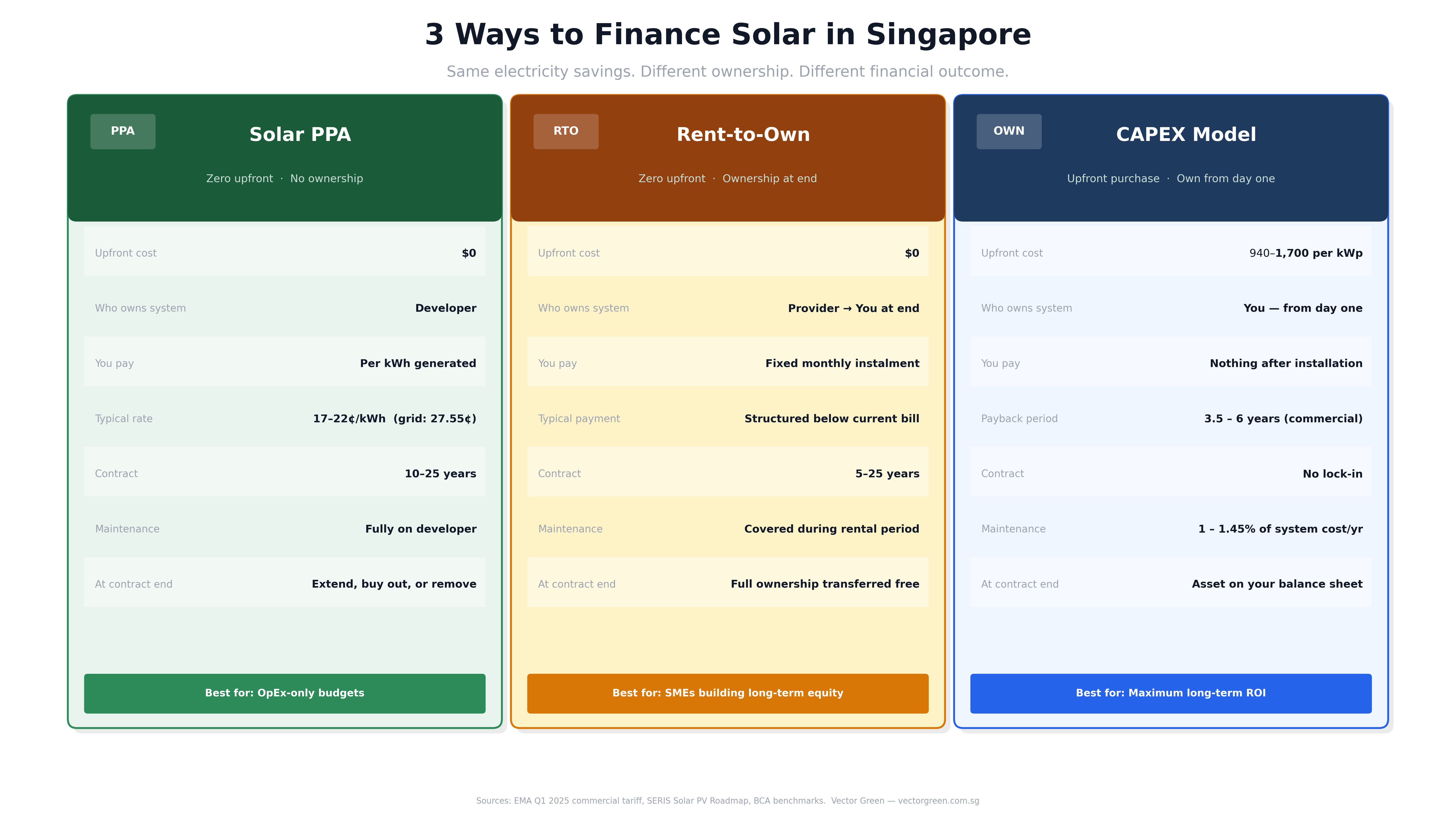
What is solar financing and how does it reduce electricity cost?
Solar financing refers to the different ways a business can install and benefit from solar energy without necessarily paying the full system cost upfront.
In simple terms, solar reduces electricity cost by allowing businesses to generate their own power at a lower cost than purchasing electricity from the grid. The extent of savings depends on how the system is financed, who owns it, and how the financial benefits are structured over time.
In Singapore, three primary solar financing models are commonly used: Power Purchase Agreements (PPA), rent-to-own structures, and outright ownership through capital expenditure (CAPEX). Each model delivers cost savings differently and suits different business profiles.
Power Purchase Agreements (PPA): immediate savings with no upfront cost
A Power Purchase Agreement (PPA) is the most widely adopted model for organisations seeking immediate cost reduction without upfront investment. Under a PPA, a solar developer installs, owns, and maintains the system on your rooftop at no capital cost. In return, you agree to purchase the electricity generated at a fixed rate per kWh over a contract period that typically ranges from 10 to 25 years.
The cost advantage comes from the difference between the PPA rate and the grid tariff. In Singapore, PPA rates generally range between 17 to 22 cents per kWh. When compared to the prevailing tariff of 27.55 cents, this creates an immediate saving on every unit of solar electricity consumed. For buildings where solar can offset a meaningful portion of total consumption, this translates into consistent monthly savings without any capital outlay.
Operationally, the appeal of a PPA lies in its simplicity. The developer assumes responsibility for installation, system performance, maintenance, and insurance. From the building owner’s perspective, solar becomes a utility cost rather than an asset, with no operational burden attached.
However, this structure comes with trade-offs. Because the system is not owned by you, the long-term financial upside is shared with the developer. Additionally, PPA contracts are long-term commitments, and exiting early—due to relocation, asset sale, or tenancy changes—can involve substantial termination costs.
A PPA is the right choice when your organisation has no appetite for capital expenditure, your building lease comfortably covers the contract period, and your priority is immediate bill reduction with zero upfront cost and zero maintenance responsibility. Because a PPA is treated as an operating expense rather than capital investment, it suits businesses where CAPEX requires board-level approval.
Rent-to-Own solar: balancing cash flow and long-term cost reduction
Rent-to-own models sit between PPAs and outright ownership, offering a hybrid approach that balances affordability with long-term asset ownership. Under this structure, a provider installs the solar system with no upfront cost, and you pay fixed monthly instalments over a defined period, typically between 5 and 25 years. At the end of the term, ownership of the system transfers to you at no additional cost.
The financial logic differs from a PPA. Instead of paying per kWh generated, your monthly payment is fixed regardless of system output. This introduces a different type of exposure: while you benefit from stable payments, variations in system performance affect your effective savings rather than the provider’s revenue.
In well-structured agreements, monthly instalments are calibrated to be lower than the electricity cost savings generated by the system, allowing for positive cash flow from the outset. Over time, as payments conclude and ownership transfers, the full benefit of low-cost solar electricity accrues to the building owner.
Rent-to-own is the right choice when your organisation wants to build equity in the solar asset over time, your cash flow supports the fixed monthly payment, and you intend to remain in the building for the full contract term. It suits SMEs that want long-term ownership benefits without committing $100,000 or more in capital today. Some providers also offer early buyout options after year five, allowing you to purchase the system outright if your financial position improves before the contract concludes.
Outright ownership (CAPEX): maximising long-term electricity cost reduction
For organisations with available capital or access to financing, outright ownership delivers the highest long-term reduction in electricity cost. Under this model, the solar system is purchased upfront, making it a capital asset from day one. All electricity generated directly offsets grid consumption, and the full financial benefit is retained by the owner.
System costs in Singapore vary based on scale, with larger installations benefiting from lower per-kWp pricing. While the initial investment can be substantial, the financial returns are equally compelling. Payback periods for commercial systems typically range from 3.5 to 6 years, with internal rates of return between 10% and 16%. Once the system has paid for itself, it continues to generate electricity at minimal marginal cost for the remainder of its lifespan, which often exceeds 20 years.
Ownership also introduces strategic advantages beyond direct cost savings. The system becomes a tangible asset on the balance sheet, contributes to building valuation, and provides long-term energy cost certainty—an increasingly important factor as Singapore’s carbon pricing framework evolves.
However, this model requires upfront capital and a willingness to manage or outsource ongoing maintenance. It is best suited to organisations with long-term occupancy plans and a focus on maximising financial return rather than minimising short-term cash outflow.
Which solar financing model reduces electricity cost the most?
Each financing model reduces electricity cost, but the extent and timing of savings differ.
Outright ownership delivers the highest total savings over the system’s lifetime, as all generated electricity directly offsets grid consumption without revenue sharing. Rent-to-own provides a balance between affordability and long-term benefit, enabling gradual asset ownership while maintaining positive cash flow. PPAs offer the fastest path to immediate savings with zero upfront cost, but with lower lifetime financial returns due to the developer’s share.
The right choice depends less on the technology and more on your organisation’s financial position, time horizon, and risk tolerance. A model that maximises savings on paper may not be practical if it conflicts with capital constraints or operational flexibility.
How solar fits into a broader strategy to reduce electricity cost
Solar should not be viewed in isolation, but as part of a broader strategy to reduce electricity cost in commercial buildings. While operational improvements such as HVAC and lighting optimisation address inefficiencies, solar addresses the cost of energy itself. The most effective approach combines both—reducing unnecessary consumption first, then lowering the cost of the remaining demand.
For organisations evaluating their next step, the key is not simply choosing a financing model, but understanding how solar integrates with existing consumption patterns, building infrastructure, and long-term business plans. A poorly aligned system or contract structure can limit savings, even if the technology itself is sound.
👉 To understand how to reduce electricity cost holistically, read: how to reduce electricity cost in Singapore commercial buildings
👉 To identify inefficiencies before investing in solar, read: why electricity bills are high in Singapore commercial buildings
From evaluation to action
If you are exploring ways to reduce electricity cost in your commercial building, solar is one of the most impactful levers available—but only when implemented with the right financial structure.
The decision between PPA, rent-to-own, and outright ownership is not purely technical. It is a strategic financial decision that affects cash flow, asset value, and long-term flexibility. The optimal solution depends on your building’s consumption profile, your capital position, and how long you intend to hold or occupy the asset.
Vector Green works with commercial building owners, procurement teams, and facility managers across Singapore to evaluate solar feasibility, model financial outcomes across different financing options, and design implementation strategies aligned with both operational and financial objectives.
If you want to understand which solar model best supports your goal of reducing electricity cost, the next step is not assumption—it is analysis.
Frequently Asked Questions About Solar Financing in Singapore
What is the best solar financing option in Singapore?
The best option depends on your financial goals. PPAs offer immediate savings with no upfront cost, while ownership delivers the highest long-term returns.
Does solar really reduce electricity cost for businesses?
Yes. Solar allows businesses to generate electricity at a lower cost than grid tariffs, reducing overall electricity expenses.
Is a PPA better than buying solar panels?
A PPA is better for businesses that prioritise cash flow and flexibility, while ownership is better for maximising long-term savings.
How long does it take to see savings from solar?
Savings can begin immediately under a PPA, while ownership models typically achieve full payback within several years.
energy and assets
